
Self-Criticism Versus Self-Compassion: Strategies to Shift Your Mindset
Throughout our lives, we form thoughts and opinions about most things, including other people, the environment we live in, and ourselves. The thoughts we have of ourselves can guide our entire belief system and shift how we interact with the world, which can have a significant impact on our daily lives. These thoughts may be brief moments where we interpret how something went, such as “I did really well at that” or “my presentation was terrible.” They also may be longer lasting thoughts that guide our views of ourselves as a person: “I am a caring person” or “messing up that project shows how bad I am.” Self-criticisms become more likely to be longer lasting the more often they are reinforced, either by others or ourselves.

What is Self-Criticism?
Self-criticism involves evaluating yourself and your actions harshly or with judgment. This form of self-talk may be the result of a variety of things, including the messages you have heard from others in your life, societal pressures, or self-esteem concerns. Often, people are hesitant to change a critical mindset if they believe criticisms are needed to motivate themselves or that showing themselves compassion will prevent growth. However, in reality, self-criticism can often have a significant mental health impact, such as lower mood or increased anxiety. Additionally, it can also impact our ability to engage in daily activities, as self-criticism may make a task feel unapproachable or impossible. If you are feeling critical of your ability to effectively complete a task, it may feel challenging to begin that task in the first place and can ultimately lead to avoiding it altogether. Self-criticism may also lead one to doubt their ability to make changes in their own life.
What is Self-Compassion?
To answer what self-compassion is, we must first clarify what it is not. Self-compassion is not toxic positivity or an excuse for our behaviors. It does not mean pretending that we have never made mistakes or that everything has gone perfectly. The goal is not to be ingenuine or dishonest with yourself, although this belief often prevents people from practicing self-compassion. Instead, it is approaching those moments with empathy and recognizing your humanity. Self-compassion involves looking at moments where we have made a mistake and allowing grace anyway, rather than defining ourselves by our mistakes.
As defined by Dr. Kristin Neff, Ph.D. there are three main components of self-compassion:
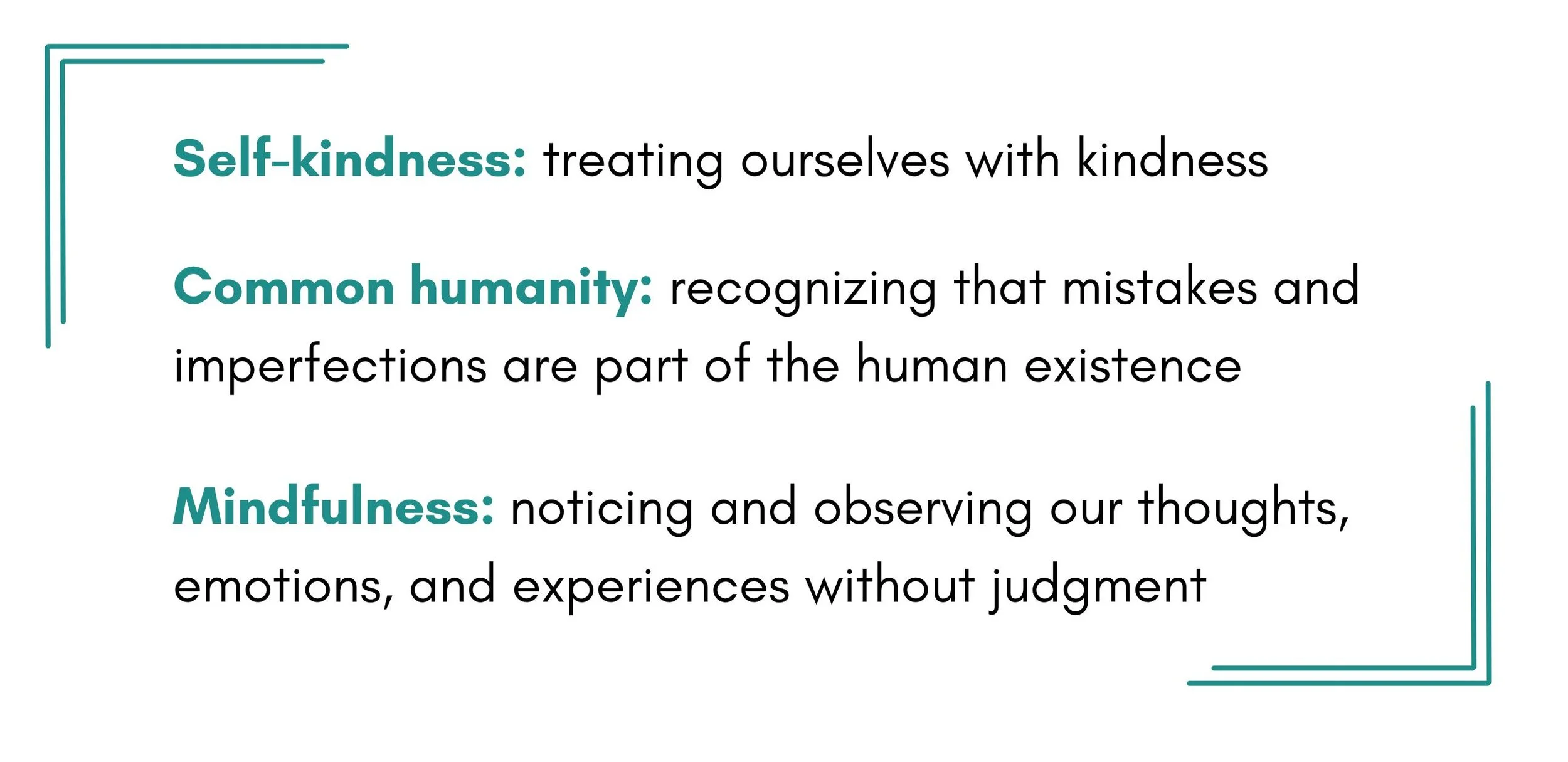
The goal of self-compassion work is to recognize ourselves as human and to approach ourselves with understanding. However, this is often something that does not come automatically and we have to intentionally choose to practice it. It is not always easy to be compassionate with ourselves.
How Do I Practice Self-Compassion?
In order to practice self-compassion, we must first recognize our patterns of self-criticism. At times it may be very apparent, but other times it may be more subtle. We may tell ourselves “I should have known better” or “I should have done that differently.” While this may not sound as overtly critical, these thoughts still communicate a judgment of ourselves for the choices we did (or did not) make.
It may at times feel impossible to shift our mindset. Much of self-compassion work is not forcing out the existence of these thoughts. That goal can feel unachievable and self-compassion may start to feel impossible. If our focus is on fighting the very existence of our thoughts, it can easily become exhausting. Instead, our goal is learning alternate ways to respond when these thoughts occur.

What are Some Self-Compassion Strategies?
There are several different methods to practice engaging in more self-compassion.
Ask yourself how you would respond to a friend. If a friend or loved one approached you with the same concerns and was talking about themselves in the same way, how might you respond to them? Likely you would respond to them in a nonjudgmental way.
Imagine how you would respond if others said the same messages to you. In many instances, you might be upset if someone talked to you the way you may be talking about yourself.
RAIN mindfulness practice

Additional Resources on Practicing Self-Compassion
Kristin Neff,Self-Compassion Institute